The Yeti Crab: Deep-Sea Marvel with Hairy Pincers and a Chemosynthetic Lifestyle


Animal Information
The Yeti Crab: Deep-Sea Marvel with Hairy Pincers and a Chemosynthetic Lifestyle

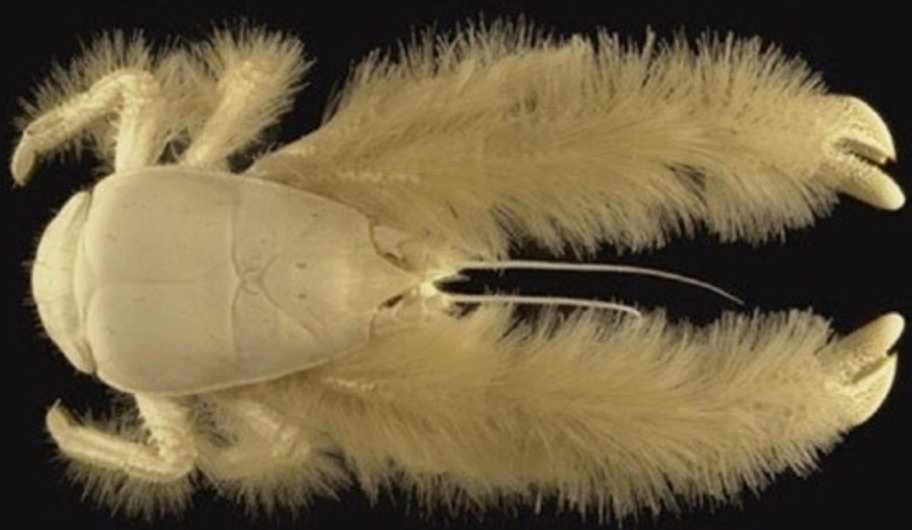
Discovered in 2005 near hydrothermal vents off Easter Island, the yeti crab (Kiwa hirsuta) is a crustacean unlike any other—renowned for its fuzzy, blond "hair" covering its pincers and body, earning it the nickname "yeti crab." This deep-sea dweller thrives in one of Earth’s most extreme environments, relying on a unique partnership with bacteria for survival.


Hairy Armor and Adaptations to the Abyss

  • Feathery Fibrils for Survival
    The crab’s most iconic feature is its dense covering of setae (hair-like structures) on its chelipeds (pincers) and thorax. These fibrils host colonies of chemosynthetic bacteria, which convert toxic hydrogen sulfide from hydrothermal vents into energy—a process called chemosynthesis. The crab "farms" these bacteria by waving its pincers in vent plumes, providing them with nutrients while feeding on their byproducts.
  • Blind but Sensitive
    Lacking functional eyes in the pitch-black depths, it navigates using sensory hairs that detect temperature, chemical gradients, and water movement. Its white exoskeleton reflects the faint light from vent fluids, while a stocky body (reaching 15 cm in length) withstands the crushing pressures of 2,200 meters below sea level.

Life in the Vent Ecosystem

  • Reproduction and Behavior
    Females carry fertilized eggs attached to their abdominal pleopods, protecting them in the toxic vent environment. Mating rituals remain unknown, but researchers suspect they communicate via chemical signals. Unlike many deep-sea creatures, yeti crabs are active crawlers, moving between vent fields to find optimal bacterial growth conditions.
  • Ecological Niche
    As primary consumers in vent ecosystems, they recycle nutrients and serve as prey for larger deep-sea animals like octopuses and fish. Their presence indicates the health of hydrothermal vent communities, which rely on chemosynthesis rather than photosynthesis as an energy base.

Scientific Significance and Conservation Concerns

  • Frontiers of Deep-Sea Biology
    The yeti crab’s discovery revolutionized understanding of life in extreme environments. Its bacterial symbiosis offers clues to early life on Earth and potential extraterrestrial life on ocean worlds like Jupiter’s moon Europa. Genetic studies show it belongs to a unique family (Kiwaidae), diverging from other crabs millions of years ago.
  • Threats from Deep-Sea Mining
    While currently listed as "Data Deficient" by the IUCN, yeti crabs face emerging risks from deep-sea mining operations, which could destroy hydrothermal vent habitats. Their specialized lifestyle makes them highly vulnerable to habitat loss, as they cannot survive outside vent ecosystems.


The yeti crab, with its fuzzy pincers and alien-like existence, embodies the mystery of Earth’s final frontiers. In the pitch-black, scalding-hot depths, it has evolved a survival strategy as remarkable as its appearance—reminding humanity that even in the most inhospitable places, life finds a way to thrive through partnership and adaptation.
Latest Stories
Feline News2 minute readThe Kurilian Bobtail Longhair, a captivating breed hailing from Russia’s Sakhalin Island and the Kuril Archipelago, has emerged as a fascinating subject in the international feline community. With its distinctive bobbed tail and striking appearance, this natural breed is garnering recognition for its unique history, robust health, and affectionate demeanor.
Life News2 minute readOn the streets and alleys of Italy, gelato is more than just a refreshing dessert; it is a vivid embodiment of the country's culinary philosophy. Compared to the common American ice cream, this Italian classic has become an irreplaceable culinary symbol in the hearts of food lovers worldwide, thanks to its unique craftsmanship and texture.
Feline News2 minute readIn 1982, a bald kitten with an unusual genetic mutation emerged in a barn on an Oregon cherry farm, marking the accidental birth of one of the world’s most distinctive feline breeds—the LaPerm. This curly-coated wonder, named for its "wavy" or "rippled" fur, has since captivated cat lovers globally with its unique appearance and playful personality .
Feline News1 minute readThe Brazilian Shorthair, a distinctive feline breed native to Brazil, has captivated cat enthusiasts with its charming personality and adaptable nature. Originating from the country's street cats, the breed was formally recognized in the 1980s after decades of selective breeding to preserve its unique traits.
Feline News1 minute readIn recent days, a cat named Marguerite has quietly risen to fame in a suburban community. The 3-year-old orange-and-white feline, once a street stray, has now become a "heartwarming bond" connecting neighbors.
Feline News2 minute readOriginating from the city of Rostov-on-Don in Russia, the Donskoy cat, also known as the Don Sphynx, has captivated feline enthusiasts worldwide with its unique appearance and affectionate demeanor. First discovered in 1987 when Professor Elena Kovaleva rescued a hairless kitten named Varvara, the breed emerged from a natural genetic mutation that resulted in a lack of fur. Varvara’s subsequent litters produced both haired and hairless kittens, leading breeder Irina Nemykina to develop the Donskoy through selective breeding with European Shorthairs. Recognized by The International Cat Associat
Feline News2 minute readThe Nebelung, a captivating feline often mistaken for the Russian Blue, is a rare breed celebrated for its striking appearance and gentle demeanor. Originating in the U.S. during the 1980s, this breed emerged from intentional crossbreeding to replicate the elegance of Victorian-era long-haired blue cats. Named after the German word "nebel" (meaning "mist"), the Nebelung’s silvery-tipped blue-gray coat evokes a misty aura, while its green or yellow-green eyes add to its enigmatic charm.