The Sunda Colugo: An Indonesian Native That's Neither a Monkey Nor a True Flyer


Animal Information
The Sunda Colugo: An Indonesian Native That's Neither a Monkey Nor a True Flyer

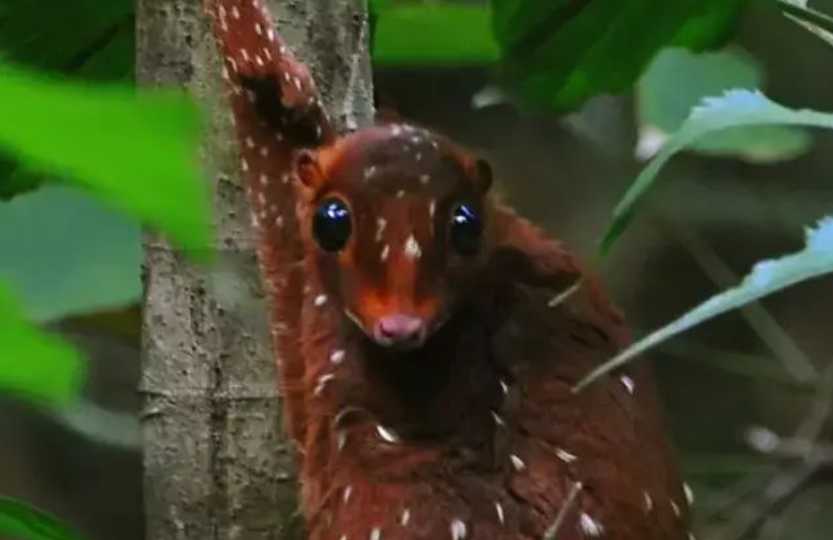
Native to the rainforests of Indonesia, Malaysia, and Thailand, the Sunda colugo (Galeopterus variegatus) confuses observers with its misleading name. Despite being called a "cat monkey" in some regions, this arboreal mammal belongs to the order Dermoptera—and rather than flying, it performs an astonishing glide that spans up to 100 meters between trees.


A Gliding Specialist with a Misleading Moniker

The colugo’s most remarkable feature is its patagium—a stretch of skin extending from its wrists to ankles, forming a parachute-like membrane that allows it to glide between trees. This adaptation, more efficient than the glides of flying squirrels, lets it navigate dense forests without descending to the ground. Contrary to its "monkey" label, it lacks a tail and has claws instead of grasping hands, resembling a large flying squirrel more than a primate. Its face, with large eyes and a rounded snout, gives it a cat-like appearance, hence the nickname "flying lemur"—though it’s unrelated to lemurs too.

Nocturnal Life and Conservation Threats

Active at night, the Sunda colugo feeds on leaves, flowers, and tree sap, using its sharp teeth to scrape bark. It sleeps during the day, curled in tree hollows or under branches, relying on camouflage to avoid predators like clouded leopards and eagles. Despite its impressive gliding skills, it cannot generate lift like birds or bats, making it a master of controlled descent rather than true flight. Deforestation poses the gravest threat to colugos, as habitat fragmentation destroys their glide paths and food sources. Listed as Near Threatened by the IUCN, they depend on intact rainforests to survive—a reminder that Indonesia’s rich biodiversity includes creatures that defy easy classification.


For biologists, the Sunda colugo is a testament to evolutionary innovation: a mammal that conquered the canopy not by flying, but by perfecting the art of gliding. Its existence challenges our assumptions about taxonomic labels, proving that nature’s most fascinating creatures often thrive in the gaps between categories. As deforestation threatens its home, the colugo’s silent glide through the treetops serves as both a marvel of adaptation and a warning about the fragility of Earth’s unique species.

Latest Stories
Feline News2 minute readThe Kurilian Bobtail Longhair, a captivating breed hailing from Russia’s Sakhalin Island and the Kuril Archipelago, has emerged as a fascinating subject in the international feline community. With its distinctive bobbed tail and striking appearance, this natural breed is garnering recognition for its unique history, robust health, and affectionate demeanor.
Life News2 minute readOn the streets and alleys of Italy, gelato is more than just a refreshing dessert; it is a vivid embodiment of the country's culinary philosophy. Compared to the common American ice cream, this Italian classic has become an irreplaceable culinary symbol in the hearts of food lovers worldwide, thanks to its unique craftsmanship and texture.
Feline News2 minute readIn 1982, a bald kitten with an unusual genetic mutation emerged in a barn on an Oregon cherry farm, marking the accidental birth of one of the world’s most distinctive feline breeds—the LaPerm. This curly-coated wonder, named for its "wavy" or "rippled" fur, has since captivated cat lovers globally with its unique appearance and playful personality .
Feline News1 minute readThe Brazilian Shorthair, a distinctive feline breed native to Brazil, has captivated cat enthusiasts with its charming personality and adaptable nature. Originating from the country's street cats, the breed was formally recognized in the 1980s after decades of selective breeding to preserve its unique traits.
Feline News1 minute readIn recent days, a cat named Marguerite has quietly risen to fame in a suburban community. The 3-year-old orange-and-white feline, once a street stray, has now become a "heartwarming bond" connecting neighbors.
Feline News2 minute readOriginating from the city of Rostov-on-Don in Russia, the Donskoy cat, also known as the Don Sphynx, has captivated feline enthusiasts worldwide with its unique appearance and affectionate demeanor. First discovered in 1987 when Professor Elena Kovaleva rescued a hairless kitten named Varvara, the breed emerged from a natural genetic mutation that resulted in a lack of fur. Varvara’s subsequent litters produced both haired and hairless kittens, leading breeder Irina Nemykina to develop the Donskoy through selective breeding with European Shorthairs. Recognized by The International Cat Associat
Feline News2 minute readThe Nebelung, a captivating feline often mistaken for the Russian Blue, is a rare breed celebrated for its striking appearance and gentle demeanor. Originating in the U.S. during the 1980s, this breed emerged from intentional crossbreeding to replicate the elegance of Victorian-era long-haired blue cats. Named after the German word "nebel" (meaning "mist"), the Nebelung’s silvery-tipped blue-gray coat evokes a misty aura, while its green or yellow-green eyes add to its enigmatic charm.