Intel Drops Out of Top 10 Semiconductor Companies, Faces $16.6B Quarterly Loss


Industry News
Intel Drops Out of Top 10 Semiconductor Companies, Faces $16.6B Quarterly Loss

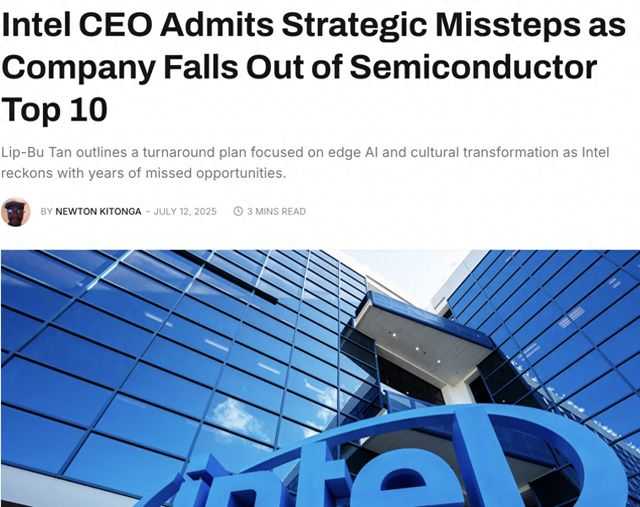
Intel CEO Lip-Bu Tan publicly acknowledged in a recent internal meeting that the company has fallen out of the global top 10 semiconductor firms due to years of strategic missteps, revealing a staggering $16.6 billion loss in Q3 2024 . This marks the worst quarterly performance in Intel’s 57-year history, driven by $15.9 billion in accelerated depreciation costs tied to underperforming Intel 7 manufacturing assets and Mobileye’s goodwill impairment . To reverse its fortunes, the board approved a new strategy centered on edge AI and agent AI, coupled with global layoffs and business restructuri


Tan identified the pivotal moment when Intel declined to supply chips for the original iPhone, allowing ARM and Qualcomm to dominate the mobile market. Recent setbacks include underwhelming x86 hybrid architectures, lukewarm reception for the Arrow Lake processor, and disappointing GPU performance, forcing Intel to outsource approximately 30% of its wafer production to TSMC—a figure projected to stabilize at 15-20% long-term . The company’s manufacturing delays even led to its flagship Nova Lake CPU being produced by TSMC’s 2nm process .


Beyond technical shifts, Tan emphasized the need to overhaul Intel’s corporate culture, slashing management layers from eight to five and mandating a four-day in-office workweek to foster collaboration . These measures aim to address systemic issues like bureaucratic inefficiency and delayed decision-making. The restructuring also involves divesting non-core assets, such as selling a 51% stake in Altera and pausing German/Polish fab projects to focus on U.S. manufacturing .


The transformation comes amid a critical industry landscape: the global semiconductor market is projected to reach $700.9 billion in 2025, with AI chips accounting for over $150 billion . However, Intel faces intense competition, as NVIDIA now commands 92% of the discrete GPU market while AMD holds 8%—Intel’s share has plummeted to 0% . Its foundry business, once a cornerstone of its turnaround plan, now captures just 0.9% of the market, dwarfed by TSMC’s 61% .


With 21,800 jobs cut since 2024—representing 20% of its workforce—and $10 billion in cost reductions underway, Intel’s survival hinges on executing its AI-centric strategy . Analysts warn that while edge AI and agent AI offer growth potential, Intel must prove it can deliver competitive products at scale to regain relevance in an industry it once dominated.

Latest Stories
Feline News2 minute readThe Kurilian Bobtail Longhair, a captivating breed hailing from Russia’s Sakhalin Island and the Kuril Archipelago, has emerged as a fascinating subject in the international feline community. With its distinctive bobbed tail and striking appearance, this natural breed is garnering recognition for its unique history, robust health, and affectionate demeanor.
Life News2 minute readOn the streets and alleys of Italy, gelato is more than just a refreshing dessert; it is a vivid embodiment of the country's culinary philosophy. Compared to the common American ice cream, this Italian classic has become an irreplaceable culinary symbol in the hearts of food lovers worldwide, thanks to its unique craftsmanship and texture.
Feline News2 minute readIn 1982, a bald kitten with an unusual genetic mutation emerged in a barn on an Oregon cherry farm, marking the accidental birth of one of the world’s most distinctive feline breeds—the LaPerm. This curly-coated wonder, named for its "wavy" or "rippled" fur, has since captivated cat lovers globally with its unique appearance and playful personality .
Feline News1 minute readThe Brazilian Shorthair, a distinctive feline breed native to Brazil, has captivated cat enthusiasts with its charming personality and adaptable nature. Originating from the country's street cats, the breed was formally recognized in the 1980s after decades of selective breeding to preserve its unique traits.
Feline News1 minute readIn recent days, a cat named Marguerite has quietly risen to fame in a suburban community. The 3-year-old orange-and-white feline, once a street stray, has now become a "heartwarming bond" connecting neighbors.
Feline News2 minute readOriginating from the city of Rostov-on-Don in Russia, the Donskoy cat, also known as the Don Sphynx, has captivated feline enthusiasts worldwide with its unique appearance and affectionate demeanor. First discovered in 1987 when Professor Elena Kovaleva rescued a hairless kitten named Varvara, the breed emerged from a natural genetic mutation that resulted in a lack of fur. Varvara’s subsequent litters produced both haired and hairless kittens, leading breeder Irina Nemykina to develop the Donskoy through selective breeding with European Shorthairs. Recognized by The International Cat Associat
Feline News2 minute readThe Nebelung, a captivating feline often mistaken for the Russian Blue, is a rare breed celebrated for its striking appearance and gentle demeanor. Originating in the U.S. during the 1980s, this breed emerged from intentional crossbreeding to replicate the elegance of Victorian-era long-haired blue cats. Named after the German word "nebel" (meaning "mist"), the Nebelung’s silvery-tipped blue-gray coat evokes a misty aura, while its green or yellow-green eyes add to its enigmatic charm.