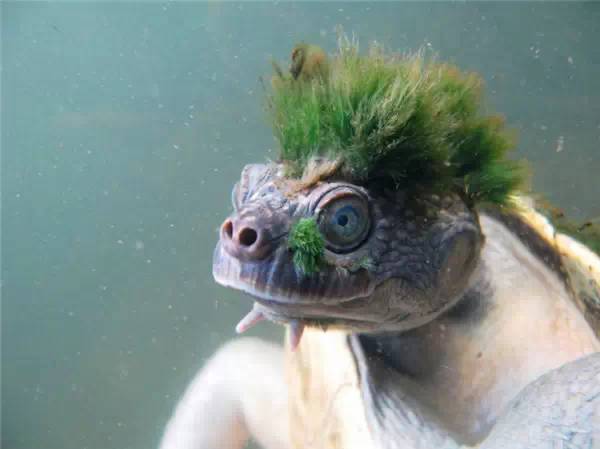
The Punk - Headed Mary River Turtle: A Unique and Endangered Species


Animal Information
The Punk - Headed Mary River Turtle: A Unique and Endangered Species

The Mary River turtle, also known as the "punk - headed turtle," is a freshwater turtle endemic to the Mary River in Queensland, Australia. It has a distinctive appearance, with strands of green algae growing on its head, which gives it the look of a punk rocker with a green Mohawk. This unique "hairdo" is not actually hair but a natural growth of algae, which adds to the turtle's charm and distinctiveness.


The Mary River turtle has some remarkable biological characteristics. One of its most unique features is its ability to breathe through gill - like structures in its cloaca, a posterior opening used for excretion and reproduction4. This allows it to stay submerged in water for up to three days, reducing the need to surface for air and helping it avoid predators4. In addition, male Mary River turtles have an unusually long tail, which can grow to nearly two - thirds the length of their carapace, and long barbels beneath their mandible, serving as sensory organs4.


Sadly, the Mary River turtle is currently facing a serious threat of extinction and is ranked 30th among the endangered reptile species3. In the 1960s and 70s, it was very popular as a pet, and more than 15,000 turtles were sold each year, which significantly reduced their numbers1. Moreover, habitat destruction, water pollution, and changes in the river's flow due to human activities such as agricultural development and dam construction have further endangered their survival4. Immediate and effective conservation measures are urgently needed to protect this unique and precious species from disappearing from the earth.
Latest Stories
Feline News2 minute readThe Kurilian Bobtail Longhair, a captivating breed hailing from Russia’s Sakhalin Island and the Kuril Archipelago, has emerged as a fascinating subject in the international feline community. With its distinctive bobbed tail and striking appearance, this natural breed is garnering recognition for its unique history, robust health, and affectionate demeanor.
Life News2 minute readOn the streets and alleys of Italy, gelato is more than just a refreshing dessert; it is a vivid embodiment of the country's culinary philosophy. Compared to the common American ice cream, this Italian classic has become an irreplaceable culinary symbol in the hearts of food lovers worldwide, thanks to its unique craftsmanship and texture.
Feline News2 minute readIn 1982, a bald kitten with an unusual genetic mutation emerged in a barn on an Oregon cherry farm, marking the accidental birth of one of the world’s most distinctive feline breeds—the LaPerm. This curly-coated wonder, named for its "wavy" or "rippled" fur, has since captivated cat lovers globally with its unique appearance and playful personality .
Feline News1 minute readThe Brazilian Shorthair, a distinctive feline breed native to Brazil, has captivated cat enthusiasts with its charming personality and adaptable nature. Originating from the country's street cats, the breed was formally recognized in the 1980s after decades of selective breeding to preserve its unique traits.
Feline News1 minute readIn recent days, a cat named Marguerite has quietly risen to fame in a suburban community. The 3-year-old orange-and-white feline, once a street stray, has now become a "heartwarming bond" connecting neighbors.
Feline News2 minute readOriginating from the city of Rostov-on-Don in Russia, the Donskoy cat, also known as the Don Sphynx, has captivated feline enthusiasts worldwide with its unique appearance and affectionate demeanor. First discovered in 1987 when Professor Elena Kovaleva rescued a hairless kitten named Varvara, the breed emerged from a natural genetic mutation that resulted in a lack of fur. Varvara’s subsequent litters produced both haired and hairless kittens, leading breeder Irina Nemykina to develop the Donskoy through selective breeding with European Shorthairs. Recognized by The International Cat Associat
Feline News2 minute readThe Nebelung, a captivating feline often mistaken for the Russian Blue, is a rare breed celebrated for its striking appearance and gentle demeanor. Originating in the U.S. during the 1980s, this breed emerged from intentional crossbreeding to replicate the elegance of Victorian-era long-haired blue cats. Named after the German word "nebel" (meaning "mist"), the Nebelung’s silvery-tipped blue-gray coat evokes a misty aura, while its green or yellow-green eyes add to its enigmatic charm.