The Olm: Nature’s Living 'Dragon' of Alpine Caves


Animal Information
The Olm: Nature’s Living 'Dragon' of Alpine Caves

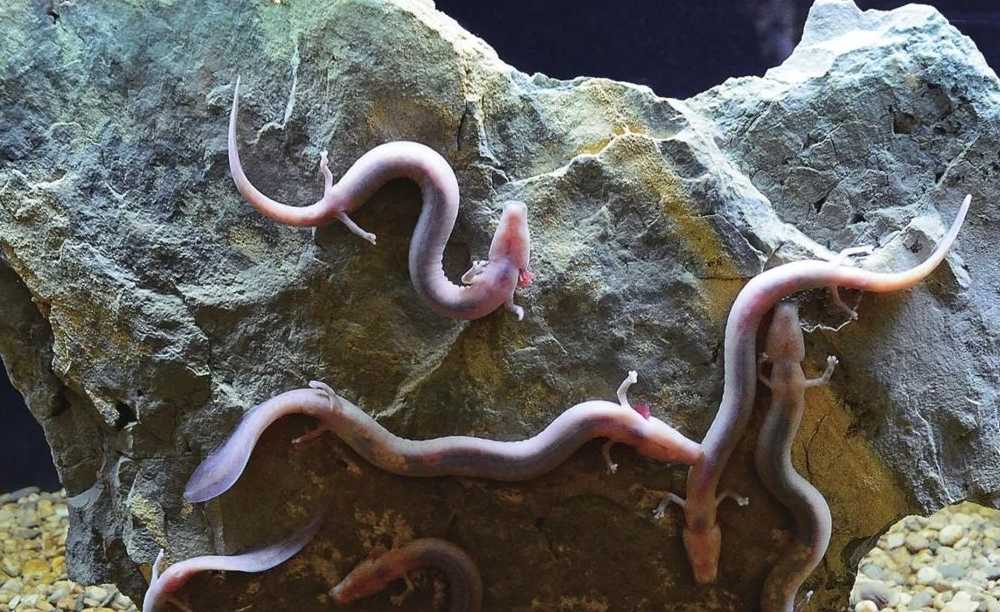
Often hailed as the closest real-life counterpart to mythical dragons, the olm (Proteus anguinus) dwells in the limestone caves of the Alps. With a serpentine body, tiny limbs, and three pairs of vibrant red feathery gills, this amphibian bears an uncanny resemblance to legendary dragon depictions—minus scales. Native to underwater cave systems in Slovenia, Croatia, and Bosnia, it has inspired myths for centuries, and its image is frequently misused in online hoaxes claiming to show "baby dragons."

A Dragon-like Anatomy Adapted to Darkness

  • Ethereal Appearance and Evolutionary Wonders
    The olm grows up to 30 cm long, with a pale, almost translucent body that lacks pigmentation—a result of its lightless habitat. Its most striking feature is the trio of bright red external gills, which extract oxygen from water and give it a mythical aura. Though it has eyes, they are underdeveloped and covered by skin, relying instead on sensory nodes along its body to detect vibrations and chemical signals.
  • Remarkable Survival Adaptations
    This cave dweller can live up to 100 years, surviving on a diet of cave-dwelling crustaceans and worms. It can endure years without food, slowing its metabolism to a crawl. Uniquely, it retains larval features into adulthood (neoteny), a rare trait in amphibians that contributes to its otherworldly appearance.

Myth, Misinformation, and Conservation

  • From Folklore to Internet Hoaxes
    In medieval times, olms were thought to be baby dragons due to their red gills and serpentine form. Today, edited photos of olms often circulate online as "真龙幼体" (baby real dragons), capitalizing on their mythical allure. Scientists have long worked to dispel these myths, emphasizing the olm’s role as a biological marvel rather than a mythical creature.
  • Threats and Protection Status
    Classified as "Vulnerable" by the IUCN, the olm faces risks from groundwater pollution, cave destruction, and climate change. Its restricted range and specialized habitat make it highly sensitive to environmental changes. Conservation efforts in Slovenia’s Postojna Cave and Croatia’s Skocjan Caves focus on preserving water quality and limiting human disturbance to its subterranean home.

Scientific Significance and Subterranean Secrets

The olm is a model organism for studying cave biology, helping scientists understand how evolution shapes species in extreme environments. Its ability to regenerate limbs and organs, coupled with its 超长 lifespan, has attracted medical researchers exploring aging and tissue repair. For cavers and biologists, it represents the mysterious world of subterranean ecosystems—reminding humanity that even in Europe’s most explored regions, nature still hides dragon-like wonders.


In the dark waters of Alpine caves, the olm swims as a living link between myth and science. Its existence challenges our understanding of life’s limits and fuels wonder at the natural world’s ability to inspire legends. As we protect this "living dragon," we safeguard not just a species, but the magic of discovery in a world still full of mysteries.
Latest Stories
Feline News2 minute readThe Kurilian Bobtail Longhair, a captivating breed hailing from Russia’s Sakhalin Island and the Kuril Archipelago, has emerged as a fascinating subject in the international feline community. With its distinctive bobbed tail and striking appearance, this natural breed is garnering recognition for its unique history, robust health, and affectionate demeanor.
Life News2 minute readOn the streets and alleys of Italy, gelato is more than just a refreshing dessert; it is a vivid embodiment of the country's culinary philosophy. Compared to the common American ice cream, this Italian classic has become an irreplaceable culinary symbol in the hearts of food lovers worldwide, thanks to its unique craftsmanship and texture.
Feline News2 minute readIn 1982, a bald kitten with an unusual genetic mutation emerged in a barn on an Oregon cherry farm, marking the accidental birth of one of the world’s most distinctive feline breeds—the LaPerm. This curly-coated wonder, named for its "wavy" or "rippled" fur, has since captivated cat lovers globally with its unique appearance and playful personality .
Feline News1 minute readThe Brazilian Shorthair, a distinctive feline breed native to Brazil, has captivated cat enthusiasts with its charming personality and adaptable nature. Originating from the country's street cats, the breed was formally recognized in the 1980s after decades of selective breeding to preserve its unique traits.
Feline News1 minute readIn recent days, a cat named Marguerite has quietly risen to fame in a suburban community. The 3-year-old orange-and-white feline, once a street stray, has now become a "heartwarming bond" connecting neighbors.
Feline News2 minute readOriginating from the city of Rostov-on-Don in Russia, the Donskoy cat, also known as the Don Sphynx, has captivated feline enthusiasts worldwide with its unique appearance and affectionate demeanor. First discovered in 1987 when Professor Elena Kovaleva rescued a hairless kitten named Varvara, the breed emerged from a natural genetic mutation that resulted in a lack of fur. Varvara’s subsequent litters produced both haired and hairless kittens, leading breeder Irina Nemykina to develop the Donskoy through selective breeding with European Shorthairs. Recognized by The International Cat Associat
Feline News2 minute readThe Nebelung, a captivating feline often mistaken for the Russian Blue, is a rare breed celebrated for its striking appearance and gentle demeanor. Originating in the U.S. during the 1980s, this breed emerged from intentional crossbreeding to replicate the elegance of Victorian-era long-haired blue cats. Named after the German word "nebel" (meaning "mist"), the Nebelung’s silvery-tipped blue-gray coat evokes a misty aura, while its green or yellow-green eyes add to its enigmatic charm.