The Glass Frog: Nature’s Transparent Amphibian with a Window to Its Inner World


Animal Information
The Glass Frog: Nature’s Transparent Amphibian with a Window to Its Inner World

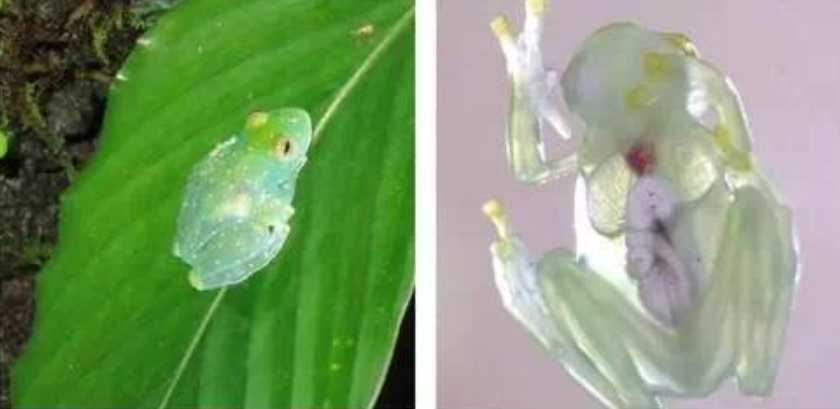
Native to the cloud forests of Central and South America, the glass frog (family Centrolenidae) is a remarkable amphibian celebrated for its most unique trait—transparent skin on its belly, allowing observers to see its beating heart, intestines, and even eggs. This evolutionary marvel has captivated biologists, offering a rare glimpse into the inner workings of a living animal.

Transparency as a Survival Strategy

  • Anatomical Wonder
    The frog’s ventral skin is so clear that organs like the liver, stomach, and ovaries are visible through the tissue. Males often have a more translucent abdomen, while females carrying eggs display greenish-yellow ova through their skin. This transparency, achieved by minimizing collagen fibers and pigment cells, helps the frog blend with sunlit leaves, making it nearly invisible to predators.
  • Physical Traits
    Ranging from 2–8 cm in length, glass frogs have lime-green dorsal skin for camouflage among foliage, large adhesive toe pads for tree-climbing, and bulging eyes that peer upward to spot prey or threats. Species like Cochranella mache have even been observed altering skin transparency by redistributing pigment cells.

Life Cycle and Ecological Role

  • Breeding in the Canopy
    Females lay eggs on the undersides of leaves overhanging streams. Males guard the clutch, keeping it moist to prevent dehydration. When tadpoles hatch, they drop into the water below, where they develop into froglets. This strategy avoids terrestrial predators but exposes them to aquatic threats like fish.
  • Insect Control and Ecosystem Health
    As insectivores, glass frogs feed on mosquitoes, ants, and small arthropods, helping control pest populations. Their sensitivity to habitat disturbance makes them excellent indicators of rainforest health; declines in their numbers signal deteriorating water quality or deforestation.

Conservation Challenges and Scientific Interest

  • Threats to Transparency
    Listed as "Vulnerable" or "Endangered" in many regions, glass frogs face risks from deforestation, climate change, and the chytrid fungus epidemic. Their reliance on specific microhabitats (e.g., streams with overhanging vegetation) makes them particularly susceptible to habitat loss.
  • Medical and Biological Insights
    Researchers study their transparent skin to understand tissue clarity and wound healing, while their unique embryonic development (outside water) provides clues to amphibian adaptation. The frog’s ability to hide internal structures without compromising organ function has even inspired materials science for transparent biomedical implants.


In the mist-shrouded forests of the Neotropics, the glass frog stands as a testament to nature’s ingenuity—an organism that turned vulnerability into a survival advantage by revealing its own biology. Its transparent body not only defies predation but also invites humanity to marvel at the delicate beauty hidden within life’s most unassuming forms.

Latest Stories
Feline News2 minute readThe Kurilian Bobtail Longhair, a captivating breed hailing from Russia’s Sakhalin Island and the Kuril Archipelago, has emerged as a fascinating subject in the international feline community. With its distinctive bobbed tail and striking appearance, this natural breed is garnering recognition for its unique history, robust health, and affectionate demeanor.
Life News2 minute readOn the streets and alleys of Italy, gelato is more than just a refreshing dessert; it is a vivid embodiment of the country's culinary philosophy. Compared to the common American ice cream, this Italian classic has become an irreplaceable culinary symbol in the hearts of food lovers worldwide, thanks to its unique craftsmanship and texture.
Feline News2 minute readIn 1982, a bald kitten with an unusual genetic mutation emerged in a barn on an Oregon cherry farm, marking the accidental birth of one of the world’s most distinctive feline breeds—the LaPerm. This curly-coated wonder, named for its "wavy" or "rippled" fur, has since captivated cat lovers globally with its unique appearance and playful personality .
Feline News1 minute readThe Brazilian Shorthair, a distinctive feline breed native to Brazil, has captivated cat enthusiasts with its charming personality and adaptable nature. Originating from the country's street cats, the breed was formally recognized in the 1980s after decades of selective breeding to preserve its unique traits.
Feline News1 minute readIn recent days, a cat named Marguerite has quietly risen to fame in a suburban community. The 3-year-old orange-and-white feline, once a street stray, has now become a "heartwarming bond" connecting neighbors.
Feline News2 minute readOriginating from the city of Rostov-on-Don in Russia, the Donskoy cat, also known as the Don Sphynx, has captivated feline enthusiasts worldwide with its unique appearance and affectionate demeanor. First discovered in 1987 when Professor Elena Kovaleva rescued a hairless kitten named Varvara, the breed emerged from a natural genetic mutation that resulted in a lack of fur. Varvara’s subsequent litters produced both haired and hairless kittens, leading breeder Irina Nemykina to develop the Donskoy through selective breeding with European Shorthairs. Recognized by The International Cat Associat
Feline News2 minute readThe Nebelung, a captivating feline often mistaken for the Russian Blue, is a rare breed celebrated for its striking appearance and gentle demeanor. Originating in the U.S. during the 1980s, this breed emerged from intentional crossbreeding to replicate the elegance of Victorian-era long-haired blue cats. Named after the German word "nebel" (meaning "mist"), the Nebelung’s silvery-tipped blue-gray coat evokes a misty aura, while its green or yellow-green eyes add to its enigmatic charm.