The Bizarre African Hydnora: A Desert Enigma


Plant Information
The Bizarre African Hydnora: A Desert Enigma

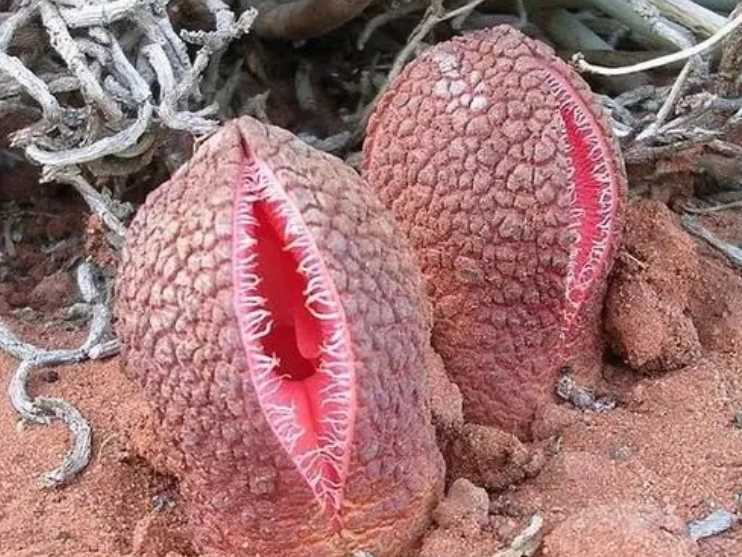
In the arid and inhospitable deserts of southern Africa, a truly extraordinary plant lurks beneath the sandy surface, emerging only to reveal its peculiar and captivating form - the African Hydnora, or Hydnora africana. This unique plant has long intrigued botanists, nature enthusiasts, and even passers - by lucky (or perhaps unlucky) enough to encounter its strange presence.

The African Hydnora is a parasitic plant, spending most of its life hidden from view. Its vegetative parts, entirely lacking in chlorophyll and leaves, resemble a fungus more than a typical plant. The plant's body consists mainly of a network of thick rhizophores - subterranean stems and roots that spread through the soil around its host plant. These fleshy, angular, and warty stems bear outgrowths similar to worms, which attach to the roots of the host, usually species of the genus Euphorbia such as E. mauritanica and E. tirucalli. It's only when the developing flowers push through the ground that the plant becomes visible.


The flowers of the African Hydnora are a sight to behold, albeit a rather unusual one. The buds develop underground and eventually emerge, reaching a height of about 100 to 150 mm. The spherical flower is brown on the outside, but its inner surface is a bright salmon to orange color. It has 3 or 4 thick, fleshy perianth lobes. Initially fused, these lobes rupture vertically as the flower matures, exposing the inner structures. The inner surface of the perianth lobes is covered in stout bristles, and the stamens are located halfway down the 10 - 20 mm wide perianth tube. What makes these flowers even more remarkable is their odor. They emit a putrid smell, similar to that of rotting meat, which is a key part of their survival strategy. This foul odor attracts carrion beetles and other insects. Once inside the flower, the insects are temporarily trapped by the bristles. As they struggle to escape, they brush against the anthers, picking up pollen, and then deposit it on the stigma as they continue to move around, thus pollinating the flower.


Despite its somewhat macabre appearance and smell, the African Hydnora has cultural and ecological significance. In some African cultures, the fruit of the plant is valued. The fruit is a sub - globose, underground berry with a thick, leathery skin. The seeds are numerous and small, embedded in a gelatinous, edible fleshy pulp that is rich in starch. Local people, as well as animals like porcupines, moles, baboons, and jackals, enjoy the fruit. In fact, the fruit is so liked by certain animals that they help in the plant's seed dispersal. After being eaten, the seeds pass through the animals' digestive systems unharmed and are deposited in new locations, allowing the African Hydnora to spread.
Latest Stories
Beauty News2 minute readBerlin-based amateur model Lena Schmidt, 26, takes the spotlight in Issue 174, with a series of posed yet natural photos capturing her in everyday Berlin settings. Shot by photographer Kai Berger, the collection balances intentionality and ease—Schmidt poses in her apartment’s sunlit kitchen, outside a historic bookstore, and along a tree-lined canal, each stance styled but never stiff.
Feline News2 minute readThe Highlander Shorthair, a newly developed cat breed in the United States, combines genetics from the American Curl, Egyptian Mau, Bengal, and other breeds, forming a distinctive appearance and temperament. Originating in 2004, it was initially named the "Highland Lynx" before being officially renamed "Highlander" in 2005. The breed earned registration with The International Cat Association (TICA) in 2008, solidifying its status as an official pedigreed cat.
Feline News2 minute readOriginating in Scotland in the 1960s, the Scottish Straight is the upright-eared counterpart to the Scottish Fold. In 1961, a white barn cat named Susie with folded ears was discovered, and some of her offspring displayed straight ears due to genetic mutation, marking the beginning of this breed’s development. Today, Scottish Straights are celebrated worldwide for their round features, gentle demeanor, and robust genetics.
Car Information1 minute readUnlike the N54’s reputation as a "modding marvel" or the B48’s "family-friendly refinement," the N20 stands as a mid-tier powerplant with clear architecture, moderate performance, and controllable potential. Its design balances daily drivability with upgrade flexibility, making it equally suited for Stage 1 bolt-ons that enhance daily driving pleasure or Stage 2–3 builds for entry-level track use.
Feline News2 minute readThe Savannah cat, a captivating hybrid of the African serval and domestic cat, has captivated pet enthusiasts worldwide with its striking appearance and dynamic personality. Originating in the U.S. in 1986, this breed was officially recognized by The International Cat Association (TICA) in 2001, solidifying its place in feline history.
Car Information1 minute readAs a fusion of long-wheelbase practicality and hatchback versatility, the F34 3 Series GT balances interior space with coupe-like styling. Sharing powertrain configurations with the F30/F35 sedan, the 320i GT and 328i GT cater to buyers seeking a blend of performance and utility, with select models offering xDrive all-wheel drive.
Industry News1 minute readIntel CEO Lip-Bu Tan publicly acknowledged in a recent internal meeting that the company has fallen out of the global top 10 semiconductor firms due to years of strategic missteps, revealing a staggering $16.6 billion loss in Q3 2024 . This marks the worst quarterly performance in Intel’s 57-year history, driven by $15.9 billion in accelerated depreciation costs tied to underperforming Intel 7 manufacturing assets and Mobileye’s goodwill impairment . To reverse its fortunes, the board approved a new strategy centered on edge AI and agent AI, coupled with global layoffs and business restructuri