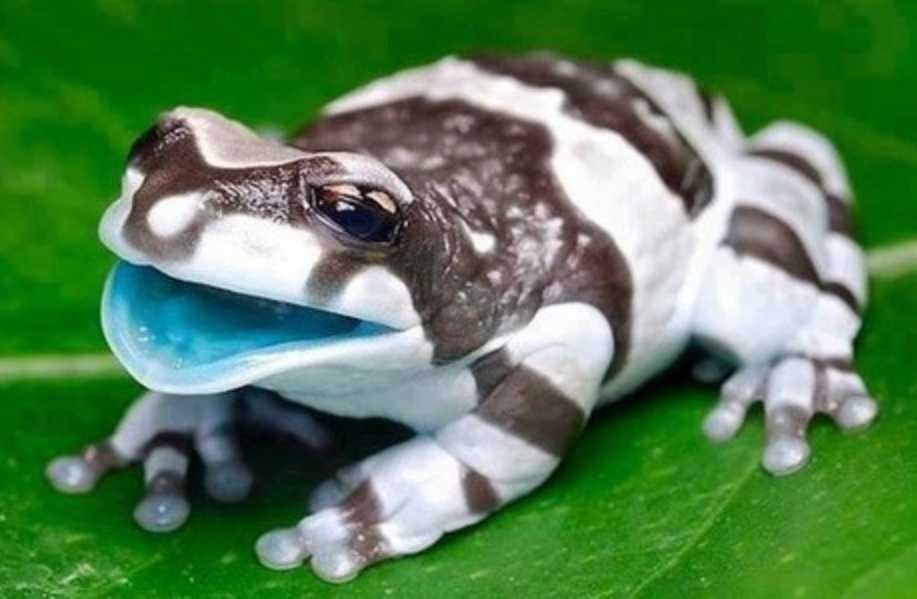
The Amazon Milk Tree Frog: Nature’s Vibrant Green Amphibian with a Milky Defense


Animal Information
The Amazon Milk Tree Frog: Nature’s Vibrant Green Amphibian with a Milky Defense

Native to the rainforests of northern South America, the Amazon milk tree frog (Trachycephalus resinifictrix) is a striking amphibian renowned for its vivid coloration and unique defensive adaptation. Found in the canopy of tropical forests from Venezuela to Brazil, this arboreal frog has captivated herpetologists with its bold appearance and the milky-white toxin it secretes when threatened.

A Canopy Dweller with Eye-Catching Traits

  • Color and Camouflage
    The frog’s dorsal skin shimmers in bright lime green, often dotted with irregular white or yellow patches, while its underside and limbs display rich blue or purple hues. This vibrant palette serves as a warning to predators, signaling its toxicity. When resting, it tucks its colorful limbs beneath its body, relying on green dorsal patterns to blend with leaves.
  • Physical Adaptations
    Growing 7–10 cm in length, it has large, adhesive toe pads for climbing trees and a stocky build. Its eyes are large and golden, with horizontal pupils that enhance night vision. When threatened, it inflates its body to appear larger and secretes a milky-white substance from skin glands—a sticky, toxic blend that irritates predators’ mouths.

Life Cycle and Rainforest Role

  • Breeding in the Canopy
    Females lay eggs in tree holes filled with water, where tadpoles develop. Males guard the clutch, calling at night with a deep, resonating croak. Tadpoles feed on algae and detritus, completing metamorphosis within weeks.
  • Ecological Balance
    As insectivores, they control populations of mosquitoes, moths, and other invertebrates. Their toxicity makes them unpalatable to most predators, though some snakes and birds have evolved resistance. Their presence indicates healthy rainforest ecosystems, as they rely on intact canopies and standing water in trees.

Conservation and Cultural Notes

While not currently endangered, the Amazon milk tree frog faces threats from deforestation, habitat fragmentation, and climate change. In local folklore, its vibrant colors are sometimes associated with protective spirits, though it is not widely used in traditional medicine. Today, it serves as an ambassador for rainforest conservation, appearing in educational programs to highlight the importance of amphibians in tropical ecosystems.


With its neon-green armor and milky defense, this frog embodies the Amazon’s evolutionary creativity—proving that in the world’s most biodiverse forests, even small creatures can thrive through bold colors and clever chemistry.

Latest Stories
Industry News1 minute readG20 finance ministers and central bank governors have issued a joint communiqué, committing to enhance international policy cooperation and sending a signal in support of multilateralism. They emphasized the need to end global trade conflicts soon and called on the U.S. and Europe to reach a fair agreement on tariffs.
Animal Information1 minute readIn the arid deserts of South America, an endangered pig-like species known locally as "taguá" (Chacoan peccary, Catagonus wagneri) is fighting for survival. These remarkable creatures have adapted uniquely to thrive in harsh desert conditions, with their diet centered on spiky cacti—an unusual food source that few other animals can exploit.
Animal Information1 minute readBeneath the waters of the Missouri River basin resides a creature that stands as a living testament to Earth's ancient past—the pallid sturgeon (Scaphirhynchus albus). Dubbed a "living fossil," this substantial fish traces its lineage back to the age of dinosaurs, persisting through tens of millions of years of geological shifts and biological evolution in these river systems.
Industry News1 minute readMicrosoft and the U.S. Idaho National Laboratory (INL) announced a partnership on July 16 to use AI in new nuclear plant licensing, aiming to drastically shorten the process. The move responds to Trump’s executive order to cut nuclear licensing to 18 months, addressing growing energy demands from AI data centers.
Industry News1 minute readThe U.S. Federal Communications Commission (FCC) announced plans on July 16 to introduce new rules, fully prohibiting any submarine communication cables containing Chinese technology or equipment from connecting to U.S. networks.
Feline News2 minute readThe Himalayan cat, a captivating fusion of Persian and Siamese genetics, has enchanted cat enthusiasts worldwide with its striking blue eyes and luxurious coat. Bred since the 1930s, this breed gained official recognition in 1957 when breeders Ben and Ann Borrett debuted their specimens at a cat show, setting standards adopted by organizations like the CFA . Nicknamed "Himmies," these cats balance elegance with affectionate charm, though their popularity demands careful attention to health and grooming.
Feline News1 minute read[Nashville, July 18th] —— The Tennessee Rex, a uniquely American cat breed celebrated for its naturally curly fur, is gaining recognition among pet enthusiasts worldwide. This distinctive feline traces its origins to a chance discovery in 2004 in Tennessee, where a stray cat gave birth to a litter containing a kitten with unusually soft, curly hair—a natural genetic mutation that marked the breed's beginning.