The Knob-billed Duck: A Large, Bizarre-Looking Waterfowl with Unique Features


Animal Information
The Knob-billed Duck: A Large, Bizarre-Looking Waterfowl with Unique Features

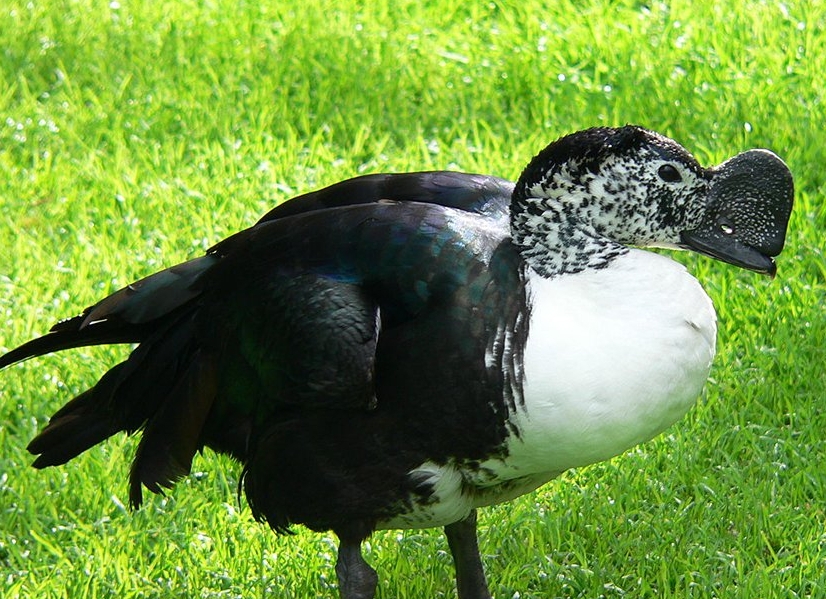
Native to wetlands across South Asia, Africa, and parts of Australia, the knob-billed duck (Sarkidiornis melanotos), named for its distinctive facial protuberance, stands out as one of the most unusual-looking waterfowl species. This large duck, with its striking appearance and quirky physical traits, has long fascinated ornithologists and birdwatchers.


A Duck with a 'Knob' and Bold Plumage

The knob-billed duck earns its name from the prominent, bony knob on adult males’ foreheads, especially during the breeding season. This knob, growing up to 5 centimeters, likely aids in mate attraction and dominance displays. Males sport a striking black-and-white plumage: a glossy black head and neck, a white body speckled with black spots, and iridescent green wings. Females, smaller and knobless, share a similar pattern but with muted tones. Reaching up to 76 centimeters in length and 2.5 kilograms in weight, these ducks are larger than most, with a robust build and a heavy, wedge-shaped bill.

Behavior and Habitat Adaptations

Unlike many ducks, knob-billed ducks prefer grazing on land, feeding on grasses, seeds, and aquatic plants. They also perch in trees, using strong claws to grip branches—rare among waterfowl. During breeding, males use their knobs to produce deep, resonating calls, while females nest in tree hollows or dense vegetation. Their bold plumage may warn predators, as their flesh is reportedly unpalatable. Found in freshwater lakes, marshes, and rice paddies, they adapt well but face threats from habitat loss and wetland degradation.

Conservation Status and Ornithological Significance

Listed as "Least Concern" by the IUCN, the knob-billed duck remains widespread, though local populations have declined due to wetland drainage and pesticide use. Its unique appearance and behavior make it vital for studying waterfowl evolution, especially sexual dimorphism and non-aquatic adaptations. In some cultures, it symbolizes resilience, while its strange looks have inspired folklore.


As one of the world’s most distinctive ducks, the knob-billed duck showcases nature’s propensity for extraordinary forms. Its bony knob, bold coloration, and quirky habits remind us that even among familiar species, wonders await observation—proof that the natural world is endlessly surprising.
Latest Stories
Feline News2 minute readThe Kurilian Bobtail Longhair, a captivating breed hailing from Russia’s Sakhalin Island and the Kuril Archipelago, has emerged as a fascinating subject in the international feline community. With its distinctive bobbed tail and striking appearance, this natural breed is garnering recognition for its unique history, robust health, and affectionate demeanor.
Life News2 minute readOn the streets and alleys of Italy, gelato is more than just a refreshing dessert; it is a vivid embodiment of the country's culinary philosophy. Compared to the common American ice cream, this Italian classic has become an irreplaceable culinary symbol in the hearts of food lovers worldwide, thanks to its unique craftsmanship and texture.
Feline News2 minute readIn 1982, a bald kitten with an unusual genetic mutation emerged in a barn on an Oregon cherry farm, marking the accidental birth of one of the world’s most distinctive feline breeds—the LaPerm. This curly-coated wonder, named for its "wavy" or "rippled" fur, has since captivated cat lovers globally with its unique appearance and playful personality .
Feline News1 minute readThe Brazilian Shorthair, a distinctive feline breed native to Brazil, has captivated cat enthusiasts with its charming personality and adaptable nature. Originating from the country's street cats, the breed was formally recognized in the 1980s after decades of selective breeding to preserve its unique traits.
Feline News1 minute readIn recent days, a cat named Marguerite has quietly risen to fame in a suburban community. The 3-year-old orange-and-white feline, once a street stray, has now become a "heartwarming bond" connecting neighbors.
Feline News2 minute readOriginating from the city of Rostov-on-Don in Russia, the Donskoy cat, also known as the Don Sphynx, has captivated feline enthusiasts worldwide with its unique appearance and affectionate demeanor. First discovered in 1987 when Professor Elena Kovaleva rescued a hairless kitten named Varvara, the breed emerged from a natural genetic mutation that resulted in a lack of fur. Varvara’s subsequent litters produced both haired and hairless kittens, leading breeder Irina Nemykina to develop the Donskoy through selective breeding with European Shorthairs. Recognized by The International Cat Associat
Feline News2 minute readThe Nebelung, a captivating feline often mistaken for the Russian Blue, is a rare breed celebrated for its striking appearance and gentle demeanor. Originating in the U.S. during the 1980s, this breed emerged from intentional crossbreeding to replicate the elegance of Victorian-era long-haired blue cats. Named after the German word "nebel" (meaning "mist"), the Nebelung’s silvery-tipped blue-gray coat evokes a misty aura, while its green or yellow-green eyes add to its enigmatic charm.