Mysterious Habenaria medusa: A Botanical Marvel Resembling Mythical Locks


Plant Information
Mysterious Habenaria medusa: A Botanical Marvel Resembling Mythical Locks

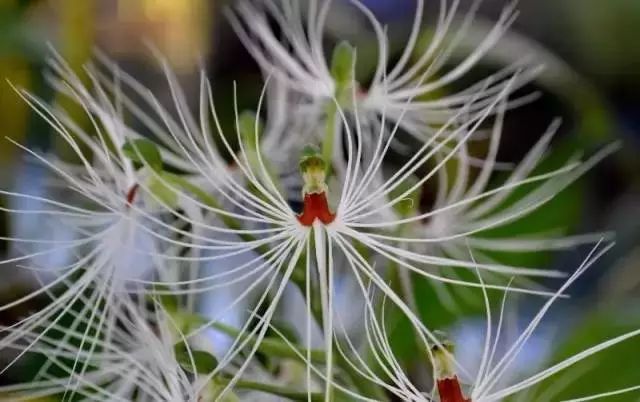
In the heart of the lush Southeast Asian rainforests, a plant of otherworldly beauty lies in wait, captivating all who encounter it. The Habenaria medusa, a member of the Orchidaceae family, has earned its name from the Greek mythological figure Medusa, whose hair was made of writhing snakes. This terrestrial orchid is a true wonder of nature, with its petals unfurling into sinuous, snake - like tendrils that seem to dance in the breeze.

The Habenaria medusa typically reaches a height of 35 - 50 centimeters. Its stem is upright and cylindrical, sprouting from a fleshy, oval - shaped tuber. Near the base of the stem, 2 - 3 tube - shaped sheaths provide support, while above them, 4 - 5 (or sometimes as many as 7) closely - grouped leaves grow. These leaves, along with 3 or more bract - like small leaves higher up, are lance - shaped with long, tapering tips. The flower cluster is densely packed, spanning 6 - 18 centimeters. The large, green - white blossoms are a sight to behold, with their unique, fringed lip petals that give the plant its distinct appearance. The blooming period, from July to August, transforms the forest floor into a fairytale scene.


Native to Indonesia and other parts of Southeast Asia, including the island of Borneo, the Habenaria medusa thrives in warm, humid environments. It prefers the dappled shade of the forest understory, where the soil is rich in organic matter and retains moisture well. This orchid has adapted to attract specific pollinators, most likely moths, with its sweet - scented nectar hidden in a spur at the back of each flower. As the moths visit the flowers in search of nectar, they inadvertently transfer pollen, ensuring the plant's reproduction.


Despite its allure, the Habenaria medusa faces numerous threats in the wild. Deforestation, driven by logging and agricultural expansion, is rapidly destroying its natural habitat. The demand for rare orchids in the horticultural trade also poses a significant risk, as illegal collection has led to a decline in its population. Conservation efforts are underway to protect this precious plant, including the establishment of protected areas and initiatives to promote sustainable cultivation. Botanists and conservationists are working together to study the plant's ecology and develop strategies to ensure its survival.


In the world of botany, the Habenaria medusa stands out as a symbol of nature's creativity and resilience. Its unique appearance and cultural significance make it a plant worth protecting. Whether admired for its beauty or studied for its ecological importance, the Habenaria medusa continues to fascinate and inspire, reminding us of the wonders that lie within our natural world.

Latest Stories
Feline News2 minute readThe Kurilian Bobtail Longhair, a captivating breed hailing from Russia’s Sakhalin Island and the Kuril Archipelago, has emerged as a fascinating subject in the international feline community. With its distinctive bobbed tail and striking appearance, this natural breed is garnering recognition for its unique history, robust health, and affectionate demeanor.
Life News2 minute readOn the streets and alleys of Italy, gelato is more than just a refreshing dessert; it is a vivid embodiment of the country's culinary philosophy. Compared to the common American ice cream, this Italian classic has become an irreplaceable culinary symbol in the hearts of food lovers worldwide, thanks to its unique craftsmanship and texture.
Feline News2 minute readIn 1982, a bald kitten with an unusual genetic mutation emerged in a barn on an Oregon cherry farm, marking the accidental birth of one of the world’s most distinctive feline breeds—the LaPerm. This curly-coated wonder, named for its "wavy" or "rippled" fur, has since captivated cat lovers globally with its unique appearance and playful personality .
Feline News1 minute readThe Brazilian Shorthair, a distinctive feline breed native to Brazil, has captivated cat enthusiasts with its charming personality and adaptable nature. Originating from the country's street cats, the breed was formally recognized in the 1980s after decades of selective breeding to preserve its unique traits.
Feline News1 minute readIn recent days, a cat named Marguerite has quietly risen to fame in a suburban community. The 3-year-old orange-and-white feline, once a street stray, has now become a "heartwarming bond" connecting neighbors.
Feline News2 minute readOriginating from the city of Rostov-on-Don in Russia, the Donskoy cat, also known as the Don Sphynx, has captivated feline enthusiasts worldwide with its unique appearance and affectionate demeanor. First discovered in 1987 when Professor Elena Kovaleva rescued a hairless kitten named Varvara, the breed emerged from a natural genetic mutation that resulted in a lack of fur. Varvara’s subsequent litters produced both haired and hairless kittens, leading breeder Irina Nemykina to develop the Donskoy through selective breeding with European Shorthairs. Recognized by The International Cat Associat
Feline News2 minute readThe Nebelung, a captivating feline often mistaken for the Russian Blue, is a rare breed celebrated for its striking appearance and gentle demeanor. Originating in the U.S. during the 1980s, this breed emerged from intentional crossbreeding to replicate the elegance of Victorian-era long-haired blue cats. Named after the German word "nebel" (meaning "mist"), the Nebelung’s silvery-tipped blue-gray coat evokes a misty aura, while its green or yellow-green eyes add to its enigmatic charm.