Exquisite Octopus Orchid: A Marvel of the Orchid World


Plant Information
Exquisite Octopus Orchid: A Marvel of the Orchid World

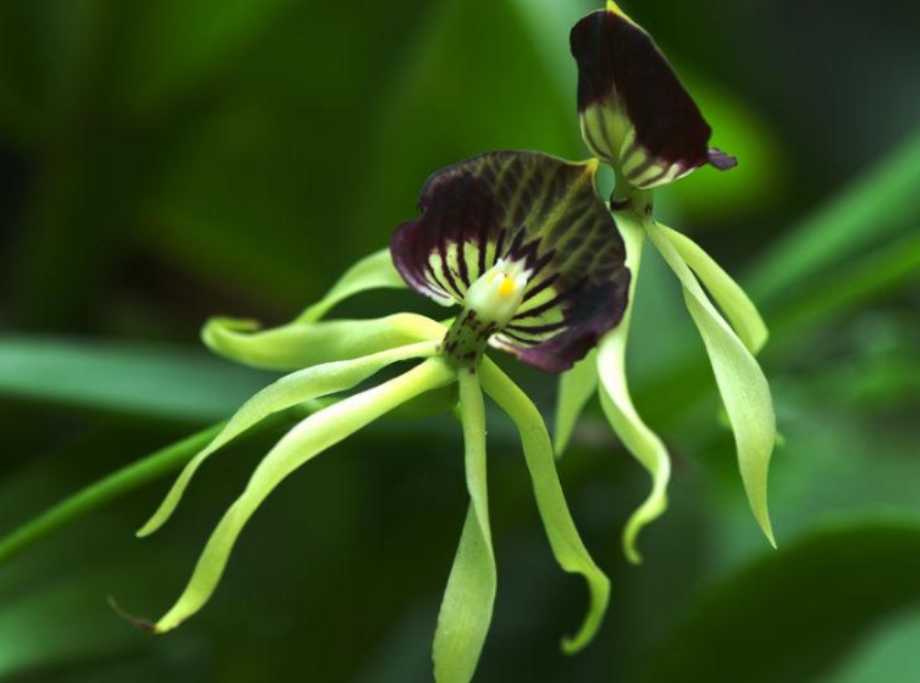
The Octopus Orchid (Prosthechea cochleata), a fascinating orchid species, is native to regions such as Central America, the West Indies, Colombia, Venezuela, and Florida in the United States. This epiphytic orchid has earned its name due to its unique flower shape that resembles a small octopus from "One Piece," with its linear petals and sepals that are yellow-green in color, slightly twisted and hanging down naturally, looking like the tentacles of an octopus. It is also known as the "Scallop Orchid" because its lip petal is just like a beautiful scallop shell.


The Octopus Orchid is a perennial epiphytic orchid with a plant height of 15-30 centimeters and a flat oval pseudobulb1. Its inflorescence is a raceme that emerges from the leaf axil of the pseudobulb, standing upright, with a flower stem length of 25-30 centimeters1. The flower has a diameter of 5-7 centimeters, and there are 10-15 scattered flowers that bloom successively from bottom to top1. It has a pleasant fragrance. The lip petal is located directly above, slightly curved inward, with the front part being yellow-green with dark purple-brown thick stripes, the two sides being dark purple, the base being white, and the ruffles being yellow1. The column is yellow-green with purple patches and is not completely fused with the lip petal1. The petals and sepals are yellow-green, without spots, linear, nearly equal, all reflexed below the lip petal, naturally drooping, and slightly twisted1. The blooming period is from summer to autumn, and the flowering period of a single flower can reach 25-30 days1.


This orchid not only has high ornamental value with its unique flower posture but is also relatively easy to grow and bloom, making it suitable for indoor display in households1. In addition, the Octopus Orchid plays an important role in the ecosystem, attracting various pollinators. With its charm and significance, it has become a beloved plant among orchid enthusiasts and collectors worldwide, and efforts are being made to protect and cultivate this precious orchid species to ensure its continued prosperity.

Latest Stories
Feline News2 minute readThe Kurilian Bobtail Longhair, a captivating breed hailing from Russia’s Sakhalin Island and the Kuril Archipelago, has emerged as a fascinating subject in the international feline community. With its distinctive bobbed tail and striking appearance, this natural breed is garnering recognition for its unique history, robust health, and affectionate demeanor.
Life News2 minute readOn the streets and alleys of Italy, gelato is more than just a refreshing dessert; it is a vivid embodiment of the country's culinary philosophy. Compared to the common American ice cream, this Italian classic has become an irreplaceable culinary symbol in the hearts of food lovers worldwide, thanks to its unique craftsmanship and texture.
Feline News2 minute readIn 1982, a bald kitten with an unusual genetic mutation emerged in a barn on an Oregon cherry farm, marking the accidental birth of one of the world’s most distinctive feline breeds—the LaPerm. This curly-coated wonder, named for its "wavy" or "rippled" fur, has since captivated cat lovers globally with its unique appearance and playful personality .
Feline News1 minute readThe Brazilian Shorthair, a distinctive feline breed native to Brazil, has captivated cat enthusiasts with its charming personality and adaptable nature. Originating from the country's street cats, the breed was formally recognized in the 1980s after decades of selective breeding to preserve its unique traits.
Feline News1 minute readIn recent days, a cat named Marguerite has quietly risen to fame in a suburban community. The 3-year-old orange-and-white feline, once a street stray, has now become a "heartwarming bond" connecting neighbors.
Feline News2 minute readOriginating from the city of Rostov-on-Don in Russia, the Donskoy cat, also known as the Don Sphynx, has captivated feline enthusiasts worldwide with its unique appearance and affectionate demeanor. First discovered in 1987 when Professor Elena Kovaleva rescued a hairless kitten named Varvara, the breed emerged from a natural genetic mutation that resulted in a lack of fur. Varvara’s subsequent litters produced both haired and hairless kittens, leading breeder Irina Nemykina to develop the Donskoy through selective breeding with European Shorthairs. Recognized by The International Cat Associat
Feline News2 minute readThe Nebelung, a captivating feline often mistaken for the Russian Blue, is a rare breed celebrated for its striking appearance and gentle demeanor. Originating in the U.S. during the 1980s, this breed emerged from intentional crossbreeding to replicate the elegance of Victorian-era long-haired blue cats. Named after the German word "nebel" (meaning "mist"), the Nebelung’s silvery-tipped blue-gray coat evokes a misty aura, while its green or yellow-green eyes add to its enigmatic charm.