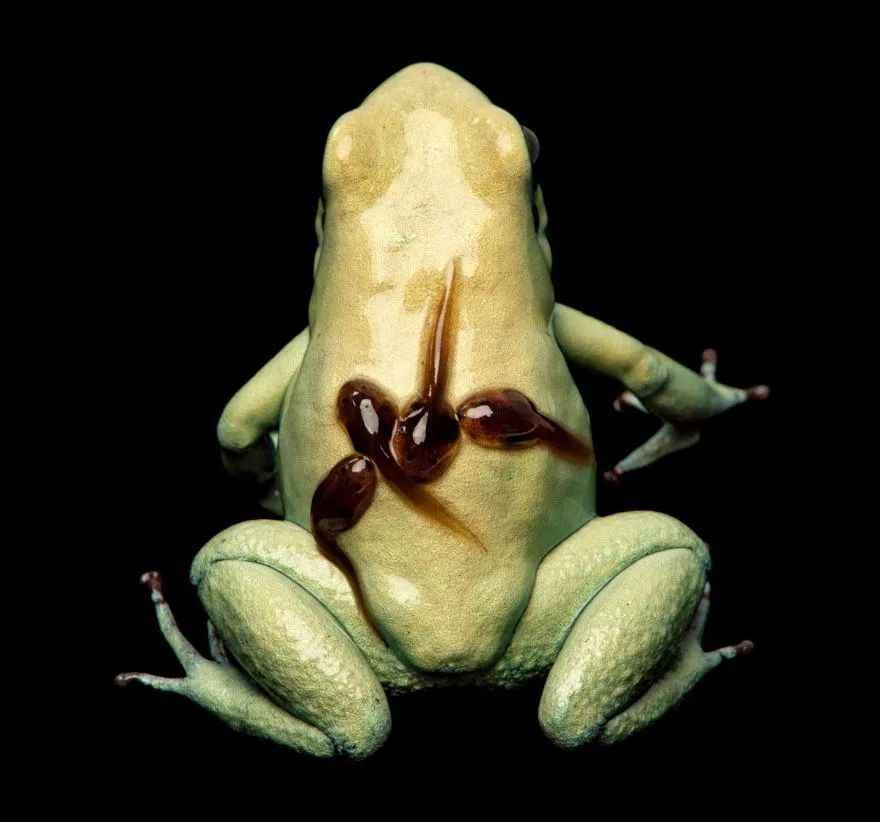
Deadly Beauty: The Endangered Plight of the Golden Poison Frog


Animal Information
Deadly Beauty: The Endangered Plight of the Golden Poison Frog

In the rainforests along Colombia’s Pacific coast resides a creature barely 5 centimeters long yet feared by all—Phyllobates terribilis, known as the golden poison frog. Cloaked in vivid orange or gold, this small amphibian ranks among the most toxic organisms on Earth. Its brilliant hue is no mere adornment, but nature’s blunt warning: keep away.


The golden poison frog’s skin glands secrete batrachotoxin, a neurotoxin so potent that just 0.2 milligrams can kill a human. A single adult frog harbors enough toxin to easily slay 10 grown men. The poison disrupts ion channels in nerve cells, causing uncontrollable muscle contractions, respiratory failure, and cardiac arrest—with no known antidote. Intriguingly, the toxin is not produced by the frog itself but accumulated through its diet of toxic insects like beetles; captive-bred individuals on controlled diets are harmless.


Despite its "invincible" defense, the golden poison frog faces endangerment. Classified as endangered by the IUCN, its wild population has plummeted over 50% in the past three decades. Primary threats include habitat destruction:  deforestation for agriculture and mining has fragmented its rainforest home. Additionally, illegal pet trade-driven poaching, fueled by demand for its striking appearance, exacerbates the crisis.


In the wild, adult golden poison frogs have few natural predators, though tadpoles fall prey to ants and spiders. They inhabit leaf litter, with females laying 5-10 eggs per clutch, guarded by males until hatching. Colombia has established protected areas and partnered with researchers on captive breeding programs to safeguard this "deadly treasure."


This creature, embodying extreme beauty and lethal danger, serves as a barometer for the health of rainforest ecosystems. Protecting the golden poison frog means preserving one of Earth’s most unique and fragile links in biodiversity.
Latest Stories
Industry News1 minute readG20 finance ministers and central bank governors have issued a joint communiqué, committing to enhance international policy cooperation and sending a signal in support of multilateralism. They emphasized the need to end global trade conflicts soon and called on the U.S. and Europe to reach a fair agreement on tariffs.
Animal Information1 minute readIn the arid deserts of South America, an endangered pig-like species known locally as "taguá" (Chacoan peccary, Catagonus wagneri) is fighting for survival. These remarkable creatures have adapted uniquely to thrive in harsh desert conditions, with their diet centered on spiky cacti—an unusual food source that few other animals can exploit.
Animal Information1 minute readBeneath the waters of the Missouri River basin resides a creature that stands as a living testament to Earth's ancient past—the pallid sturgeon (Scaphirhynchus albus). Dubbed a "living fossil," this substantial fish traces its lineage back to the age of dinosaurs, persisting through tens of millions of years of geological shifts and biological evolution in these river systems.
Industry News1 minute readMicrosoft and the U.S. Idaho National Laboratory (INL) announced a partnership on July 16 to use AI in new nuclear plant licensing, aiming to drastically shorten the process. The move responds to Trump’s executive order to cut nuclear licensing to 18 months, addressing growing energy demands from AI data centers.
Industry News1 minute readThe U.S. Federal Communications Commission (FCC) announced plans on July 16 to introduce new rules, fully prohibiting any submarine communication cables containing Chinese technology or equipment from connecting to U.S. networks.
Feline News2 minute readThe Himalayan cat, a captivating fusion of Persian and Siamese genetics, has enchanted cat enthusiasts worldwide with its striking blue eyes and luxurious coat. Bred since the 1930s, this breed gained official recognition in 1957 when breeders Ben and Ann Borrett debuted their specimens at a cat show, setting standards adopted by organizations like the CFA . Nicknamed "Himmies," these cats balance elegance with affectionate charm, though their popularity demands careful attention to health and grooming.
Feline News1 minute read[Nashville, July 18th] —— The Tennessee Rex, a uniquely American cat breed celebrated for its naturally curly fur, is gaining recognition among pet enthusiasts worldwide. This distinctive feline traces its origins to a chance discovery in 2004 in Tennessee, where a stray cat gave birth to a litter containing a kitten with unusually soft, curly hair—a natural genetic mutation that marked the breed's beginning.