The Lion's Mane Jellyfish: The Ocean's Gigantic, Frilly Predator of the Cold Depths


Animal Information
The Lion's Mane Jellyfish: The Ocean's Gigantic, Frilly Predator of the Cold Depths

The lion's mane jellyfish (Cyanea capillata) is a majestic and imposing creature, renowned as one of the largest jellyfish species in the world. Found in cold, boreal waters of the Arctic, North Atlantic, and North Pacific oceans, its name stems from its striking appearance—long, flowing tentacles resembling a lion's mane, which give it both beauty and a fearsome reputation as a predator.

A Colossal Frame and Deadly Adaptations

  • Size and Structure:
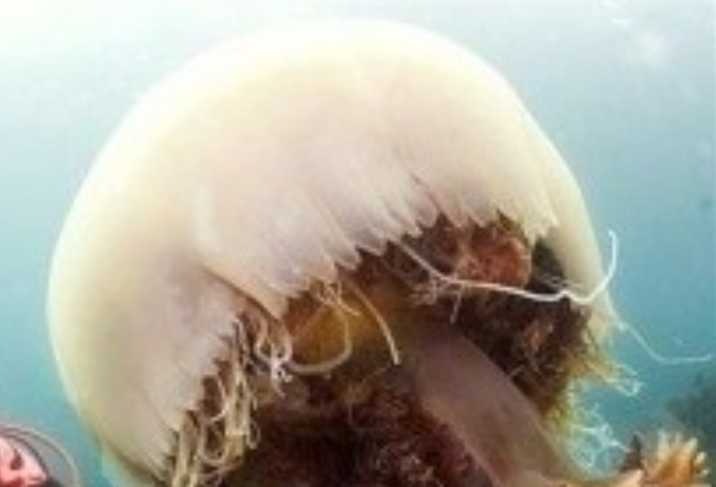
    The lion's mane jellyfish can reach astounding proportions: its bell (the dome-shaped body) may span up to 2 meters in diameter, while its tentacles—arranged in eight clusters—can stretch up to 30 meters, longer than a blue whale. This massive size makes it a top predator in its ecosystem. The bell is typically reddish-brown or golden, fading to pale pink at the edges, with a frilly oral arm structure beneath that resembles a mane.
  • Toxic Tentacles:
    Each tentacle is lined with thousands of nematocysts (stinging cells) that inject toxins into prey, such as small fish, plankton, and other jellyfish. The venom is designed to paralyze or kill, allowing the jellyfish to draw prey toward its central mouth with its oral arms. While rarely fatal to humans, encounters can cause painful stings and allergic reactions.

Life Cycle and Oceanic Role

  • Metamorphosis and Reproduction:
    Starting as tiny planula larvae, they attach to seafloor substrates and grow into polyps, which eventually bud off into ephyrae (young jellyfish). As adults, they reproduce sexually, releasing eggs and sperm into the water. Their lifespan is relatively short, typically surviving one year, with peak size reached in late summer.
  • Ecological Impact:
    As both predator and prey, lion's mane jellyfish play a key role in marine food webs. They control populations of small marine creatures, while larger animals like sea turtles and sunfish feed on them. Their massive bodies also provide habitat for smaller organisms, such as juvenile fish that seek shelter among their tentacles.

Challenges and Fascination

  • Threats and Resilience:
    While not endangered, lion's mane jellyfish face potential risks from climate change (warmer waters may alter their range) and pollution. Conversely, they can thrive in overfished areas where predators are scarce, sometimes forming large swarms that clog fishing nets or damage industrial equipment.
  • Scientific and Cultural Significance:
    Their unique physiology—including a simple nervous system and lack of a brain or heart—fascinates researchers studying animal evolution and marine biology. In folklore, their imposing presence has inspired tales of sea monsters, while their ethereal movements in the water continue to captivate divers and ocean enthusiasts.


The lion's mane jellyfish stands as a testament to nature's ability to create both beauty and intimidation in the ocean's depths. Its colossal form and ancient lineage remind humanity of the vast, mysterious world beneath the waves—a world where even the most delicate-looking creatures can wield remarkable power.

Latest Stories
Feline News2 minute readThe Kurilian Bobtail Longhair, a captivating breed hailing from Russia’s Sakhalin Island and the Kuril Archipelago, has emerged as a fascinating subject in the international feline community. With its distinctive bobbed tail and striking appearance, this natural breed is garnering recognition for its unique history, robust health, and affectionate demeanor.
Life News2 minute readOn the streets and alleys of Italy, gelato is more than just a refreshing dessert; it is a vivid embodiment of the country's culinary philosophy. Compared to the common American ice cream, this Italian classic has become an irreplaceable culinary symbol in the hearts of food lovers worldwide, thanks to its unique craftsmanship and texture.
Feline News2 minute readIn 1982, a bald kitten with an unusual genetic mutation emerged in a barn on an Oregon cherry farm, marking the accidental birth of one of the world’s most distinctive feline breeds—the LaPerm. This curly-coated wonder, named for its "wavy" or "rippled" fur, has since captivated cat lovers globally with its unique appearance and playful personality .
Feline News1 minute readThe Brazilian Shorthair, a distinctive feline breed native to Brazil, has captivated cat enthusiasts with its charming personality and adaptable nature. Originating from the country's street cats, the breed was formally recognized in the 1980s after decades of selective breeding to preserve its unique traits.
Feline News1 minute readIn recent days, a cat named Marguerite has quietly risen to fame in a suburban community. The 3-year-old orange-and-white feline, once a street stray, has now become a "heartwarming bond" connecting neighbors.
Feline News2 minute readOriginating from the city of Rostov-on-Don in Russia, the Donskoy cat, also known as the Don Sphynx, has captivated feline enthusiasts worldwide with its unique appearance and affectionate demeanor. First discovered in 1987 when Professor Elena Kovaleva rescued a hairless kitten named Varvara, the breed emerged from a natural genetic mutation that resulted in a lack of fur. Varvara’s subsequent litters produced both haired and hairless kittens, leading breeder Irina Nemykina to develop the Donskoy through selective breeding with European Shorthairs. Recognized by The International Cat Associat
Feline News2 minute readThe Nebelung, a captivating feline often mistaken for the Russian Blue, is a rare breed celebrated for its striking appearance and gentle demeanor. Originating in the U.S. during the 1980s, this breed emerged from intentional crossbreeding to replicate the elegance of Victorian-era long-haired blue cats. Named after the German word "nebel" (meaning "mist"), the Nebelung’s silvery-tipped blue-gray coat evokes a misty aura, while its green or yellow-green eyes add to its enigmatic charm.