The Kiwu Tree Viper: A Dragon-Like Venomous Snake from Central Africa


Animal Information
The Kiwu Tree Viper: A Dragon-Like Venomous Snake from Central Africa

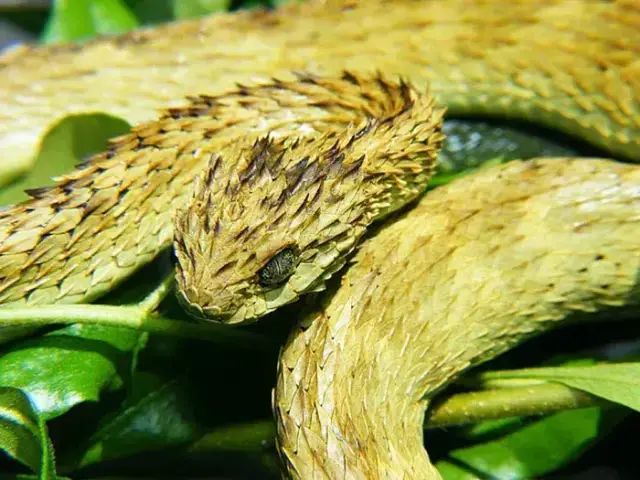
Native to the rainforests of Central Africa, the Kiwu tree viper (Atheris hispida) strikes an imposing figure, with its spiky scales and vibrant coloration earning it comparisons to mythical dragons. Found in regions like Rwanda and the Democratic Republic of Congo, this arboreal serpent combines beauty with lethality, thriving in the forest canopy as one of Africa’s most distinctive venomous species.


A Living Dragon: Physical Traits and Adaptations

The Kiwu tree viper’s most striking feature is its keeled, pointed scales, which give it a rough, "spiky" appearance—reminiscent of a dragon’s ridged hide. These scales, along with prehensile tails, allow it to grip branches effortlessly as it hunts for birds, lizards, and small mammals. Its coloration varies from vivid green to reddish-brown, often with bold yellow or white patterns that serve as both camouflage and a warning to predators. Growing up to 70 centimeters in length, it has large, front-facing eyes for depth perception and long fangs capable of injecting potent hemotoxic venom, which disrupts blood clotting and can be fatal to humans if left untreated.

Nocturnal Hunter and Conservation Concerns

Active primarily at night, the Kiwu tree viper relies on its excellent camouflage to ambush prey from tree branches. During the day, it coils among leaves or in tree hollows, blending seamlessly with its surroundings. While its dragon-like appearance may inspire awe, the species faces threats from deforestation and habitat loss, as logging and agriculture destroy its forest home. Though not yet endangered, its restricted range in the mountainous regions of Central Africa makes it vulnerable to environmental changes. Local communities often fear the viper due to its venom, but scientists emphasize its role in regulating rodent populations and maintaining ecosystem balance.


For herpetologists, the Kiwu tree viper is a testament to nature’s ability to inspire myth through reality. Its spiky scales and regal demeanor, evolved for survival in the rainforest canopy, have woven it into local folklore as a creature both feared and respected. As deforestation threatens its habitat, the viper’s existence serves as a reminder that Central Africa’s forests hold wonders as majestic as they are fragile—creatures like the Kiwu tree viper, which prove that sometimes, the most extraordinary myths are born from the natural world itself.

Latest Stories
Feline News2 minute readThe Kurilian Bobtail Longhair, a captivating breed hailing from Russia’s Sakhalin Island and the Kuril Archipelago, has emerged as a fascinating subject in the international feline community. With its distinctive bobbed tail and striking appearance, this natural breed is garnering recognition for its unique history, robust health, and affectionate demeanor.
Life News2 minute readOn the streets and alleys of Italy, gelato is more than just a refreshing dessert; it is a vivid embodiment of the country's culinary philosophy. Compared to the common American ice cream, this Italian classic has become an irreplaceable culinary symbol in the hearts of food lovers worldwide, thanks to its unique craftsmanship and texture.
Feline News2 minute readIn 1982, a bald kitten with an unusual genetic mutation emerged in a barn on an Oregon cherry farm, marking the accidental birth of one of the world’s most distinctive feline breeds—the LaPerm. This curly-coated wonder, named for its "wavy" or "rippled" fur, has since captivated cat lovers globally with its unique appearance and playful personality .
Feline News1 minute readThe Brazilian Shorthair, a distinctive feline breed native to Brazil, has captivated cat enthusiasts with its charming personality and adaptable nature. Originating from the country's street cats, the breed was formally recognized in the 1980s after decades of selective breeding to preserve its unique traits.
Feline News1 minute readIn recent days, a cat named Marguerite has quietly risen to fame in a suburban community. The 3-year-old orange-and-white feline, once a street stray, has now become a "heartwarming bond" connecting neighbors.
Feline News2 minute readOriginating from the city of Rostov-on-Don in Russia, the Donskoy cat, also known as the Don Sphynx, has captivated feline enthusiasts worldwide with its unique appearance and affectionate demeanor. First discovered in 1987 when Professor Elena Kovaleva rescued a hairless kitten named Varvara, the breed emerged from a natural genetic mutation that resulted in a lack of fur. Varvara’s subsequent litters produced both haired and hairless kittens, leading breeder Irina Nemykina to develop the Donskoy through selective breeding with European Shorthairs. Recognized by The International Cat Associat
Feline News2 minute readThe Nebelung, a captivating feline often mistaken for the Russian Blue, is a rare breed celebrated for its striking appearance and gentle demeanor. Originating in the U.S. during the 1980s, this breed emerged from intentional crossbreeding to replicate the elegance of Victorian-era long-haired blue cats. Named after the German word "nebel" (meaning "mist"), the Nebelung’s silvery-tipped blue-gray coat evokes a misty aura, while its green or yellow-green eyes add to its enigmatic charm.