The Transparent "Sea Salp": Gelatinous Marvel Thriving in Frigid Southern Oceans


Marine Biology
The Transparent "Sea Salp": Gelatinous Marvel Thriving in Frigid Southern Oceans

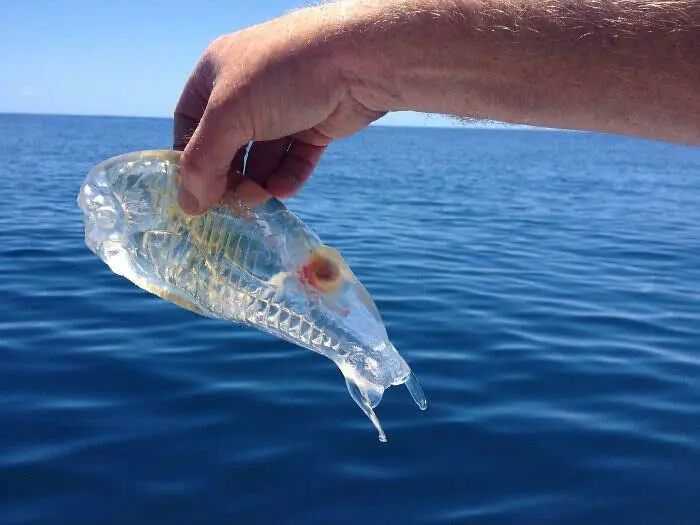
Often called the "transparent shrimp," salps are gelatinous marine tunicates renowned for their glass-like bodies, though they are not true shrimp but distant relatives of vertebrates. Primarily inhabiting cold, nutrient-rich waters, these filter feeders dominate the Southern Ocean around Antarctica, forming massive swarms that play a crucial role in global carbon cycling.


A Living Glass Tube: Anatomy and Adaptations

Salps resemble cylindrical jellyfish, with transparent bodies up to 10 cm long (though chains of individuals can stretch meters). Their gelatinous form is supported by a cellulose "tunic," and a ring of cilia inside the body creates water currents to filter plankton. This transparency serves as both camouflage and a survival strategy in the open ocean, where visibility is key to avoiding predators like fish and squid.


Their most remarkable trait is metagenesis—alternating between asexual (colonial) and sexual (solitary) life stages. Asexual individuals bud off genetically identical copies, forming long chains that float together, while sexual stages produce eggs and sperm to ensure genetic diversity.

Ecological Powerhouses of the Southern Ocean

In the frigid Southern Ocean, salps bloom in response to phytoplankton outbreaks, consuming up to their own body weight in plankton daily. As they feed, they convert tiny algae into dense fecal pellets, which sink to the ocean floor, trapping carbon dioxide—a process known as the "salp pump." This makes them vital for mitigating climate change, with some studies estimating Southern Ocean salps sequester millions of tons of carbon annually.


Their swarms also serve as a food source for whales, seals, and seabirds. When abundant, salps can outcompete krill, altering food web dynamics—a phenomenon being studied as Antarctic waters warm.

Vulnerability and Climate Change Implications

While salps thrive in cold waters, they are sensitive to ocean acidification and warming. Rising temperatures in the Southern Ocean may shift their range or disrupt their life cycle, threatening both their carbon-sequestering role and dependent species. Scientists monitor salp populations closely, recognizing their importance as indicators of Antarctic marine health.


In the icy expanse of the Southern Ocean, these transparent tunicates embody nature’s ability to thrive in extremes. Their gelatinous forms, though fragile in appearance, drive ecological processes that sustain life on a planetary scale—reminding humanity of the hidden power in Earth’s most remote and seemingly barren waters.

Latest Stories
Industry News1 minute readG20 finance ministers and central bank governors have issued a joint communiqué, committing to enhance international policy cooperation and sending a signal in support of multilateralism. They emphasized the need to end global trade conflicts soon and called on the U.S. and Europe to reach a fair agreement on tariffs.
Animal Information1 minute readIn the arid deserts of South America, an endangered pig-like species known locally as "taguá" (Chacoan peccary, Catagonus wagneri) is fighting for survival. These remarkable creatures have adapted uniquely to thrive in harsh desert conditions, with their diet centered on spiky cacti—an unusual food source that few other animals can exploit.
Animal Information1 minute readBeneath the waters of the Missouri River basin resides a creature that stands as a living testament to Earth's ancient past—the pallid sturgeon (Scaphirhynchus albus). Dubbed a "living fossil," this substantial fish traces its lineage back to the age of dinosaurs, persisting through tens of millions of years of geological shifts and biological evolution in these river systems.
Industry News1 minute readMicrosoft and the U.S. Idaho National Laboratory (INL) announced a partnership on July 16 to use AI in new nuclear plant licensing, aiming to drastically shorten the process. The move responds to Trump’s executive order to cut nuclear licensing to 18 months, addressing growing energy demands from AI data centers.
Industry News1 minute readThe U.S. Federal Communications Commission (FCC) announced plans on July 16 to introduce new rules, fully prohibiting any submarine communication cables containing Chinese technology or equipment from connecting to U.S. networks.
Feline News2 minute readThe Himalayan cat, a captivating fusion of Persian and Siamese genetics, has enchanted cat enthusiasts worldwide with its striking blue eyes and luxurious coat. Bred since the 1930s, this breed gained official recognition in 1957 when breeders Ben and Ann Borrett debuted their specimens at a cat show, setting standards adopted by organizations like the CFA . Nicknamed "Himmies," these cats balance elegance with affectionate charm, though their popularity demands careful attention to health and grooming.
Feline News1 minute read[Nashville, July 18th] —— The Tennessee Rex, a uniquely American cat breed celebrated for its naturally curly fur, is gaining recognition among pet enthusiasts worldwide. This distinctive feline traces its origins to a chance discovery in 2004 in Tennessee, where a stray cat gave birth to a litter containing a kitten with unusually soft, curly hair—a natural genetic mutation that marked the breed's beginning.