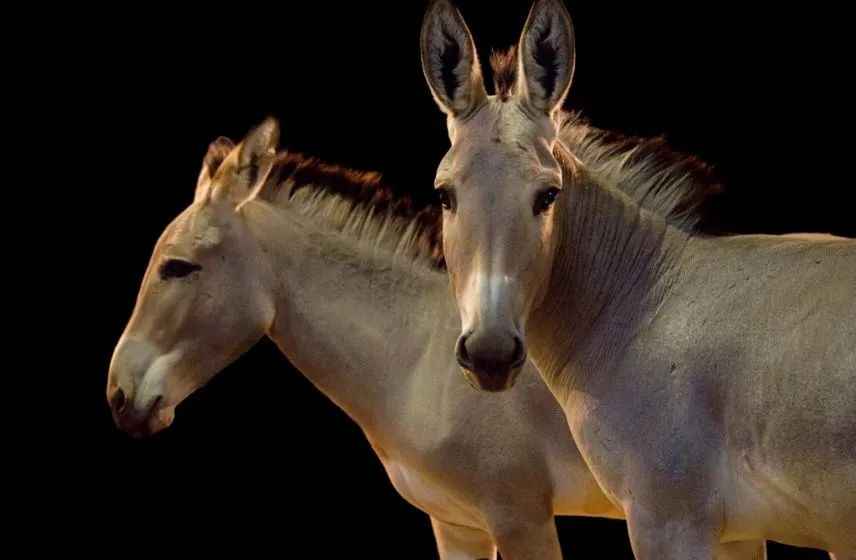
Somali Wild Ass: East Africa’s Critically Endangered "Living Fossil" Faces Extinction Crisis


Animal Information
Somali Wild Ass: East Africa’s Critically Endangered "Living Fossil" Faces Extinction Crisis

In the arid semi-deserts of the Horn of Africa lives an elegant and resilient creature—the Somali wild ass (Equus africanus somaliensis). As one of the wild ancestors of modern domestic donkeys, they once thrived in the dry grasslands and hills of Ethiopia, Eritrea, and Somalia. However, a combination of climate change, habitat loss, and human activities is pushing this species to the brink of extinction.

Survival Struggles: Double Jeopardy of Drought and Conflict

The Horn of Africa has experienced a marked increase in drought frequency and intensity over the past two decades, directly degrading the Somali wild ass’s habitat. Shrinking grasslands force them to compete with livestock for limited water and forage, exacerbating malnutrition and disease risks. For instance, the 2021 drought in northeastern Kenya killed at least 200 Somali giraffes, a fate mirrored in wild ass populations.


Warfare and communal conflicts further escalate threats. Illegal hunting persists due to weapon proliferation in parts of Somalia and Ethiopia, where their meat and body parts are sought for food and traditional medicine. Herders also kill them to protect livestock, while genetic purity is compromised by hybridization with domestic donkeys.

Ecological Value and Conservation Efforts

As a keystone species in arid ecosystems, Somali wild asses dig "ass wells" to access groundwater, inadvertently providing water sources for other animals and enhancing biodiversity. This behavior is critical amid desert expansion caused by climate change, even fostering plant seedling growth.


International efforts to save them include captive breeding and habitat protection. The UK’s Marwell Zoo recently celebrated a successful birth, offering hope for population survival. In Africa, Kenya’s Hirola Conservation Programme employs community collaboration, establishing reserves, providing emergency water, and combating diseases to balance wild ass and human needs. However, the IUCN Red List estimates fewer than 1,000 remain in the wild, with some sources suggesting less than 200, underscoring the urgency.

Future Outlook: The Long Road from "Crisis" to "Recovery"

Protecting Somali wild asses requires transboundary cooperation and long-term investment. Experts advocate expanding protected areas, strengthening anti-poaching patrols, and integrating communities into conservation education. For example, community-led monitoring programs in northern Ethiopia have shown initial success. Genetic studies also highlight their unique divergence from domestic donkeys, underscoring their irreplaceable value for biodiversity research
Latest Stories
Industry News1 minute readG20 finance ministers and central bank governors have issued a joint communiqué, committing to enhance international policy cooperation and sending a signal in support of multilateralism. They emphasized the need to end global trade conflicts soon and called on the U.S. and Europe to reach a fair agreement on tariffs.
Animal Information1 minute readIn the arid deserts of South America, an endangered pig-like species known locally as "taguá" (Chacoan peccary, Catagonus wagneri) is fighting for survival. These remarkable creatures have adapted uniquely to thrive in harsh desert conditions, with their diet centered on spiky cacti—an unusual food source that few other animals can exploit.
Animal Information1 minute readBeneath the waters of the Missouri River basin resides a creature that stands as a living testament to Earth's ancient past—the pallid sturgeon (Scaphirhynchus albus). Dubbed a "living fossil," this substantial fish traces its lineage back to the age of dinosaurs, persisting through tens of millions of years of geological shifts and biological evolution in these river systems.
Industry News1 minute readMicrosoft and the U.S. Idaho National Laboratory (INL) announced a partnership on July 16 to use AI in new nuclear plant licensing, aiming to drastically shorten the process. The move responds to Trump’s executive order to cut nuclear licensing to 18 months, addressing growing energy demands from AI data centers.
Industry News1 minute readThe U.S. Federal Communications Commission (FCC) announced plans on July 16 to introduce new rules, fully prohibiting any submarine communication cables containing Chinese technology or equipment from connecting to U.S. networks.
Feline News2 minute readThe Himalayan cat, a captivating fusion of Persian and Siamese genetics, has enchanted cat enthusiasts worldwide with its striking blue eyes and luxurious coat. Bred since the 1930s, this breed gained official recognition in 1957 when breeders Ben and Ann Borrett debuted their specimens at a cat show, setting standards adopted by organizations like the CFA . Nicknamed "Himmies," these cats balance elegance with affectionate charm, though their popularity demands careful attention to health and grooming.
Feline News1 minute read[Nashville, July 18th] —— The Tennessee Rex, a uniquely American cat breed celebrated for its naturally curly fur, is gaining recognition among pet enthusiasts worldwide. This distinctive feline traces its origins to a chance discovery in 2004 in Tennessee, where a stray cat gave birth to a litter containing a kitten with unusually soft, curly hair—a natural genetic mutation that marked the breed's beginning.