Sargocentron punctatissimum: The Black-Banded Soldierfish of Coral Reefs


Marine Biology
Sargocentron punctatissimum: The Black-Banded Soldierfish of Coral Reefs

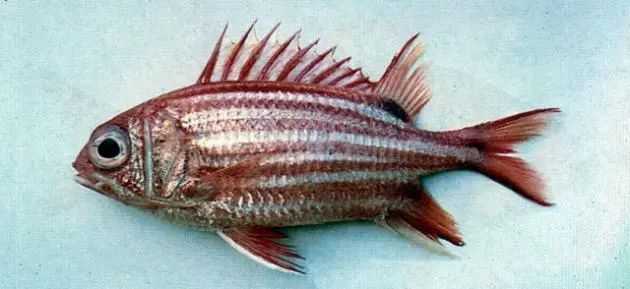
Sargocentron punctatissimum, a striking species within the Holocentridae family, is commonly known by regional nicknames such as "golden scale armor" and "general’s armor," reflecting its vibrant appearance and robust structure. Inhabiting the warm tropical waters of the Indo-Pacific, this fish is characterized by a deep, laterally compressed body clad in large, rough scales with a bold red base color, accented by a prominent black horizontal band across its midsection and numerous small white spots, creating a visually striking pattern.


Growing up to 30 centimeters in length, the black-banded soldierfish features large, reflective eyes adapted for low-light activity, a hallmark of its nocturnal lifestyle. Its dorsal fin is armed with sharp spines, providing defense against predators, while the soft-rayed posterior portion aids in maneuverability among coral branches. By day, it seeks shelter in crevices, caves, or under overhangs of coral reefs, often forming dense groups to reduce individual predation risk. At night, it emerges to forage for small crustaceans, mollusks, and zooplankton, using its keen senses to detect prey in the dark.


Distributed from the Red Sea and East Africa to the waters of Japan, Australia, and French Polynesia, Sargocentron punctatissimum plays a vital role in reef ecosystems as both a mesopredator and a prey species for larger fish. Its bold coloration serves as a warning to potential predators of its spiny defenses, while the black band may aid in camouflage or social recognition within schools. Though not targeted for commercial fishing due to its small size and firm flesh, it is occasionally caught for local subsistence or the aquarium trade, valued for its vivid colors in reef displays. However, like many reef-dependent species, it faces threats from coral degradation, pollution, and destructive fishing practices. Conservation efforts focused on preserving coral habitats and promoting sustainable aquarium collection are crucial to ensuring its survival. As a symbol of the resilience and beauty of tropical reefs, this black-banded soldierfish highlights the interconnectedness of all marine life and the need for proactive conservation to protect these fragile ecosystems.
Latest Stories
Feline News2 minute readThe Kurilian Bobtail Longhair, a captivating breed hailing from Russia’s Sakhalin Island and the Kuril Archipelago, has emerged as a fascinating subject in the international feline community. With its distinctive bobbed tail and striking appearance, this natural breed is garnering recognition for its unique history, robust health, and affectionate demeanor.
Life News2 minute readOn the streets and alleys of Italy, gelato is more than just a refreshing dessert; it is a vivid embodiment of the country's culinary philosophy. Compared to the common American ice cream, this Italian classic has become an irreplaceable culinary symbol in the hearts of food lovers worldwide, thanks to its unique craftsmanship and texture.
Feline News2 minute readIn 1982, a bald kitten with an unusual genetic mutation emerged in a barn on an Oregon cherry farm, marking the accidental birth of one of the world’s most distinctive feline breeds—the LaPerm. This curly-coated wonder, named for its "wavy" or "rippled" fur, has since captivated cat lovers globally with its unique appearance and playful personality .
Feline News1 minute readThe Brazilian Shorthair, a distinctive feline breed native to Brazil, has captivated cat enthusiasts with its charming personality and adaptable nature. Originating from the country's street cats, the breed was formally recognized in the 1980s after decades of selective breeding to preserve its unique traits.
Feline News1 minute readIn recent days, a cat named Marguerite has quietly risen to fame in a suburban community. The 3-year-old orange-and-white feline, once a street stray, has now become a "heartwarming bond" connecting neighbors.
Feline News2 minute readOriginating from the city of Rostov-on-Don in Russia, the Donskoy cat, also known as the Don Sphynx, has captivated feline enthusiasts worldwide with its unique appearance and affectionate demeanor. First discovered in 1987 when Professor Elena Kovaleva rescued a hairless kitten named Varvara, the breed emerged from a natural genetic mutation that resulted in a lack of fur. Varvara’s subsequent litters produced both haired and hairless kittens, leading breeder Irina Nemykina to develop the Donskoy through selective breeding with European Shorthairs. Recognized by The International Cat Associat
Feline News2 minute readThe Nebelung, a captivating feline often mistaken for the Russian Blue, is a rare breed celebrated for its striking appearance and gentle demeanor. Originating in the U.S. during the 1980s, this breed emerged from intentional crossbreeding to replicate the elegance of Victorian-era long-haired blue cats. Named after the German word "nebel" (meaning "mist"), the Nebelung’s silvery-tipped blue-gray coat evokes a misty aura, while its green or yellow-green eyes add to its enigmatic charm.